Enzyme-Converted Type O Whole Blood
A major compatibility advance, but does it preserve oxygen delivery?
What the study tested
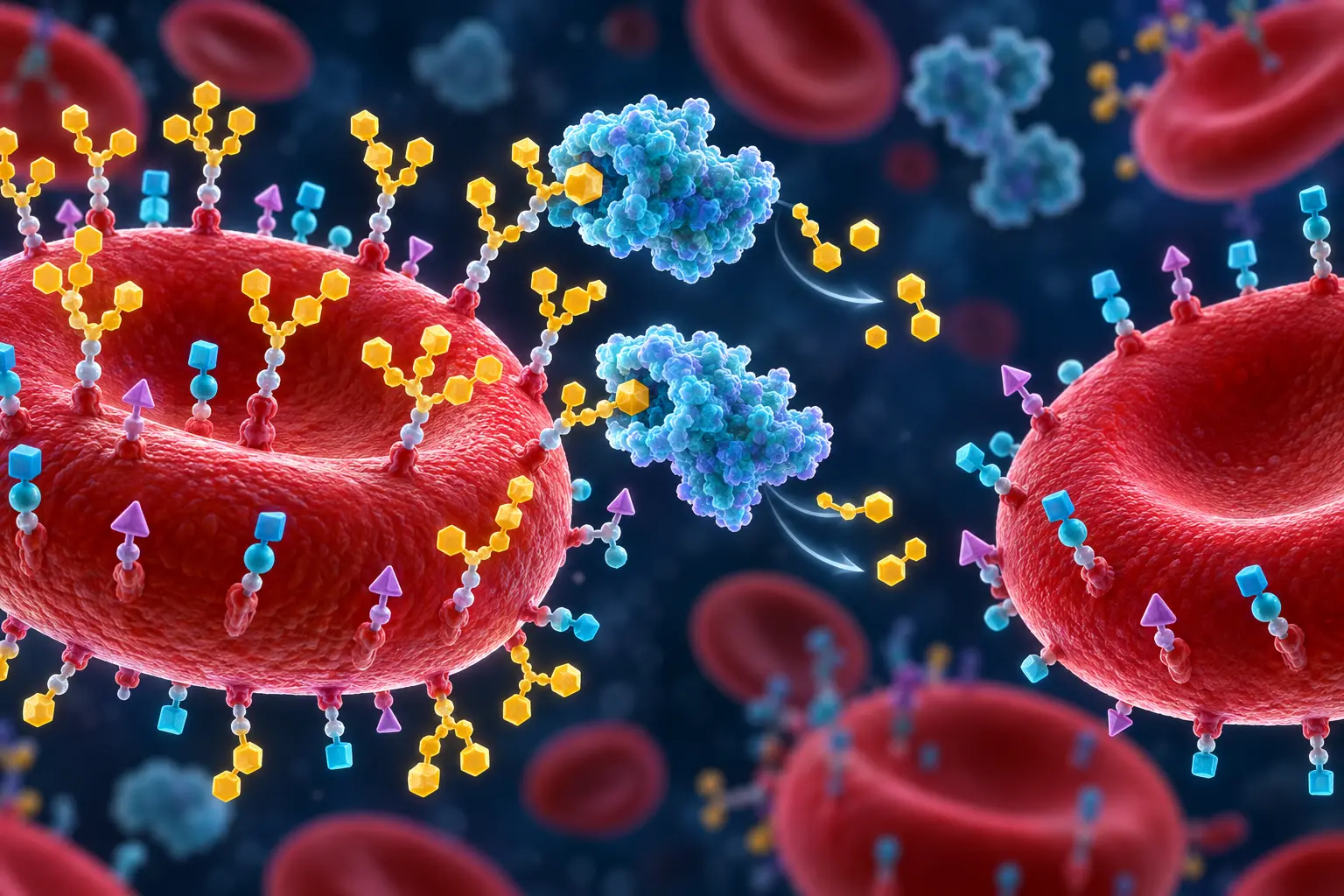
Nowadly and colleagues tested an enzyme process designed to remove A-antigen structures from type A swine whole blood and produce an O-like blood-group profile. The experiment used blood from 16 type A and four type O swine.
The investigators also assessed complete blood counts, blood gases, rotational thromboelastometry, osmotic fragility and free haemoglobin.
What the result may solve
The approach may reduce ABO-mediated incompatibility by removing selected terminal A-antigen structures. If it can be translated, validated and manufactured reliably, it could make existing donor blood more flexible across blood groups.
Important boundary: this is not pig-to-human blood and it does not remove “pig immunogenicity” broadly. Swine were the experimental model. The process targets the A blood-group antigen and does not erase the full red-cell antigen profile.
What it does not yet solve
- Non-ABO antigens, including Rh, Kell, Duffy, Kidd and other clinically important systems.
- Dependence on donor collection, testing, storage, cold chain and inventory rotation.
- Long-term storage stability after enzyme treatment.
- In vivo red-cell recovery, circulation time and survival after processing.
- Proven tissue oxygen delivery after conversion.
Reducing one compatibility barrier is scientifically important. It is not the same as demonstrating preserved therapeutic function.
The oxygen-delivery questions
- Does enzyme treatment change P50, the Hill coefficient or the Bohr effect?
- Are ATP and 2,3-DPG preserved through processing and storage?
- Does red-cell deformability remain adequate under microvascular flow?
- How do oxygen unloading, tissue extraction and organ-level oxygenation compare with untreated blood?
- What is the usable shelf life after conversion, and does function deteriorate during storage?
These endpoints are necessary before a compatibility conversion can also be described as a successful oxygen-delivery technology.
Primary publication
Nowadly CD, et al. Enzymatic conversion of type A to type O whole blood in a swine model. Transfusion. 2026;66(3):568–578. DOI · PubMed