The South African National Blood Service (SANBS) needs to collect approximately 3,500 units of donated blood every day to meet demand and maintain reserve stocks. It serves eight of South Africa’s nine provinces. The Western Cape has a separate blood service. [1]
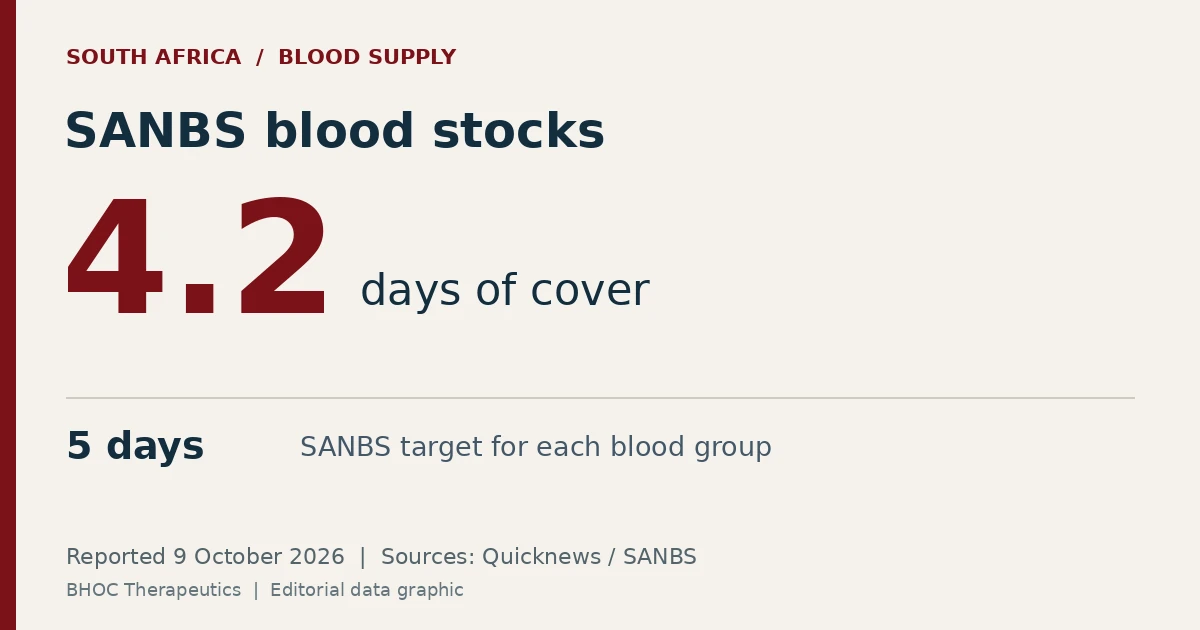
A report published on 9 October 2026 placed SANBS blood stocks at 4.2 days of cover. SANBS aims to maintain five days of stock for each blood group. [2] [3]
For comparison, published blood-service stock targets are:
| Country and service | Target stock |
|---|---|
| South Africa: SANBS | 5 days for each blood group [3] |
| England, including London: NHS Blood and Transplant | More than 6 days [4] |
| United States: American Red Cross | 5 days, described as the ideal supply [5] |
These are service-level planning targets, not identical minimum requirements for every hospital.
“Days of cover” describes how long available stocks can meet estimated demand. It does not describe the shelf life of donated blood. SANBS’s reported overall figure of 4.2 days must not be interpreted as equal availability across every blood group.
IMPORTANTFive Days of Stock. What If Disruption Lasts Longer?
Maintaining a five-day stock depends on regular replenishment.
What happens if a natural disaster, pandemic, transport disruption, prolonged power outage or another crisis interrupts collection, testing or delivery for more than five days?
A five-day stock alone cannot sustain a complete interruption of replenishment beyond five days at unchanged demand. Shortages in particular blood groups, or increased emergency demand, could create difficulties sooner.
The interruption may begin in the laboratory. Even when donors continue to give blood, shortages of test kits, reagents or essential consumables can delay the testing and release of newly collected units for routine clinical use. Blood availability depends on the entire chain, including testing, processing, reliable power, temperature-controlled storage and transport. [6] [2]
A previously unknown virus raises another question: what happens before a validated donor-screening test becomes available?
Routine screening cannot be assumed to detect every emerging pathogen. Whether a new virus threatens transfusion safety must be assessed from evidence of its presence in blood and potential for transmission. A pandemic can also disrupt supply without the virus being transmitted through transfusion. [6] [7] [8]
Preparedness therefore requires a plan for prolonged disruption: reserve laboratory supplies, backup power, alternative testing and transport routes, coordination between blood services, and clinical prioritisation if shortages develop.
The question is how patients will receive essential treatment when disruption outlasts the available stock.
The preparedness discussion above is editorial commentary. It does not describe a reported failure of SANBS’s contingency arrangements.
Sources
- SANBS: service area and daily collection target
- Quicknews: SANBS stock report, 9 October 2026
- SANBS: five-day target for each blood group and donor information
- NHS Blood and Transplant: published stock target for England
- American Red Cross: ideal five-day supply, 27 September 2021
- FDA: donation testing, blood safety and emerging infections
- AABB: emerging infectious agents and potential threats to transfusion safety
- O’Brien et al.: international blood-service research during COVID-19
BHOC: Biological Hemoglobin Oxygen Carrier · BHOC Therapeutics