Strategic Stockpiles, Modular Manufacturing and Oxygen Security
A contextual analysis of medical supply resilience, Strategic Sovereign Reserves and how validated Precision Oxygen Therapeutics could eventually support oxygen-delivery capacity in a crisis.
Why this matters
WHO planning for 2026–2027 includes strategic stockpiles of essential medical supplies, stronger emergency supply chains, research and development of medical countermeasures and access to therapeutics. WHO also emphasizes geographically diversified local and regional manufacturing. These priorities raise a question for oxygen-delivery medicine: how can health systems preserve capacity when routine supply systems are disrupted?
The World Health Assembly adopted the WHO Pandemic Agreement in May 2025. WHO described equitable access to vaccines, therapeutics and diagnostics and steps toward a Global Supply Chain and Logistics Network. The Agreement does not name BHOC or designate hemoglobin oxygen carriers as pandemic products.
Precision Oxygen Therapeutics based on Biological Hemoglobin Oxygen Carriers (BHOC) could be evaluated for a different preparedness capability: a shelf-stable, donor-independent strategic reserve, potentially supported by validated regional manufacturing. Product performance, safety, production and use would each require appropriate scientific and regulatory evidence.
Blood supply is a strategic dependency
Donor blood remains indispensable medicine. Its availability depends on donors, collection, testing, processing, storage, trained personnel, transport and functioning supply chains. WHO guidance recognizes that outbreaks and emergencies can threaten blood sufficiency and safety, including through donor shortages and disruption of critical materials and equipment.
From stockpiles to sovereign capacity
Strategic preparedness is more than the quantity stored. The longer-term objective is the ability to store, produce, quality-control and deploy life-supporting oxygen-delivery capacity where and when it is needed. Strategic Sovereign Reserves would require product-specific evidence, qualified production, effective governance and an appropriate clinical use pathway.
Ready When Every Minute Matters.
Modular robotic manufacturing
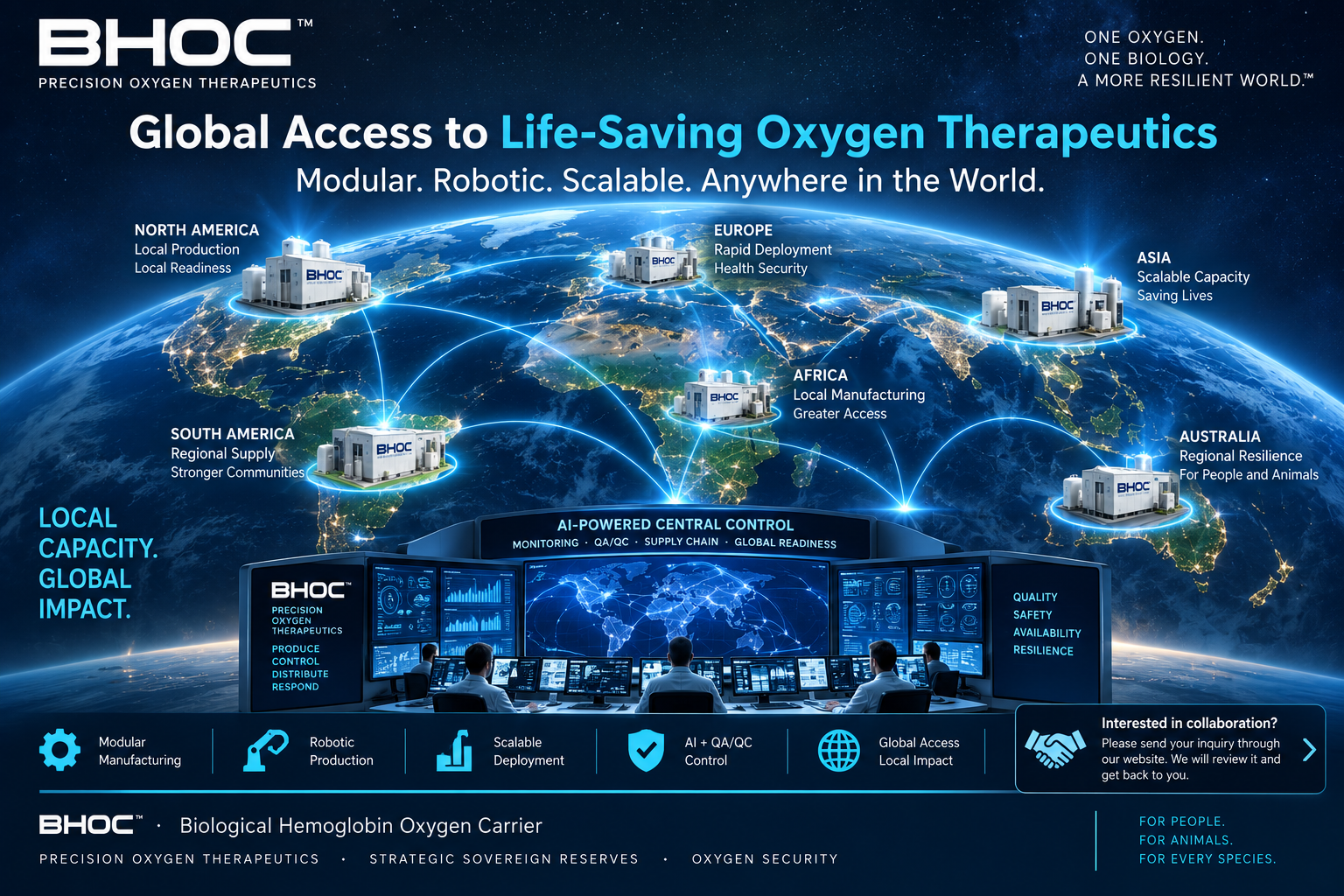
BHOC envisions modular, robotic production designed for scalable regional deployment. The aim is to combine qualified local capacity with consistent process controls and resilient supply. This remains a development objective. Each facility would need engineering, process validation, regulatory qualification, trained staff and supply-chain assurance before deployment.
AI-assisted central oversight and QA/QC
A proposed digital layer could support monitoring of process data, quality trends and distribution across regional sites. Any AI-assisted monitoring would require validation, secure data handling, accountable human review and documented QA/QC. The illustration shows a possible architecture, not a deployed control network or a substitute for facility-specific quality release.
Oxygen Security
We use Oxygen Security as an emerging BHOC policy concept: the ability of a health system to maintain access to clinically appropriate oxygen-delivery capacity during normal operations, emergencies and major disruptions. Further scientific and policy work is needed to determine whether and where oxygen therapeutics could contribute.
Contextual relevance to BHOC
BHOC is being developed within Precision Oxygen Therapeutics. Long-term objectives include shelf stability, donor-independent production, compatibility without red-cell blood-group matching by design and scalable manufacturing. These require product-specific analytical, manufacturing, preclinical, clinical and regulatory validation. WHO has not designated BHOC as a medical countermeasure, strategic-stockpile product or pandemic-preparedness technology.
We welcome proposals from governments, health systems, research institutions, manufacturers and strategic partners. Send an enquiry through BHOC Therapeutics. We will review it and respond where there is a strategic fit.
Submit a Partnership Enquiry →