Selected high-signal discussions on tissue oxygenation, microcirculation, oxygen delivery, transfusion resilience and the scientific history of Biopure, Hemopure, Oxyglobin and oxygen therapeutics.
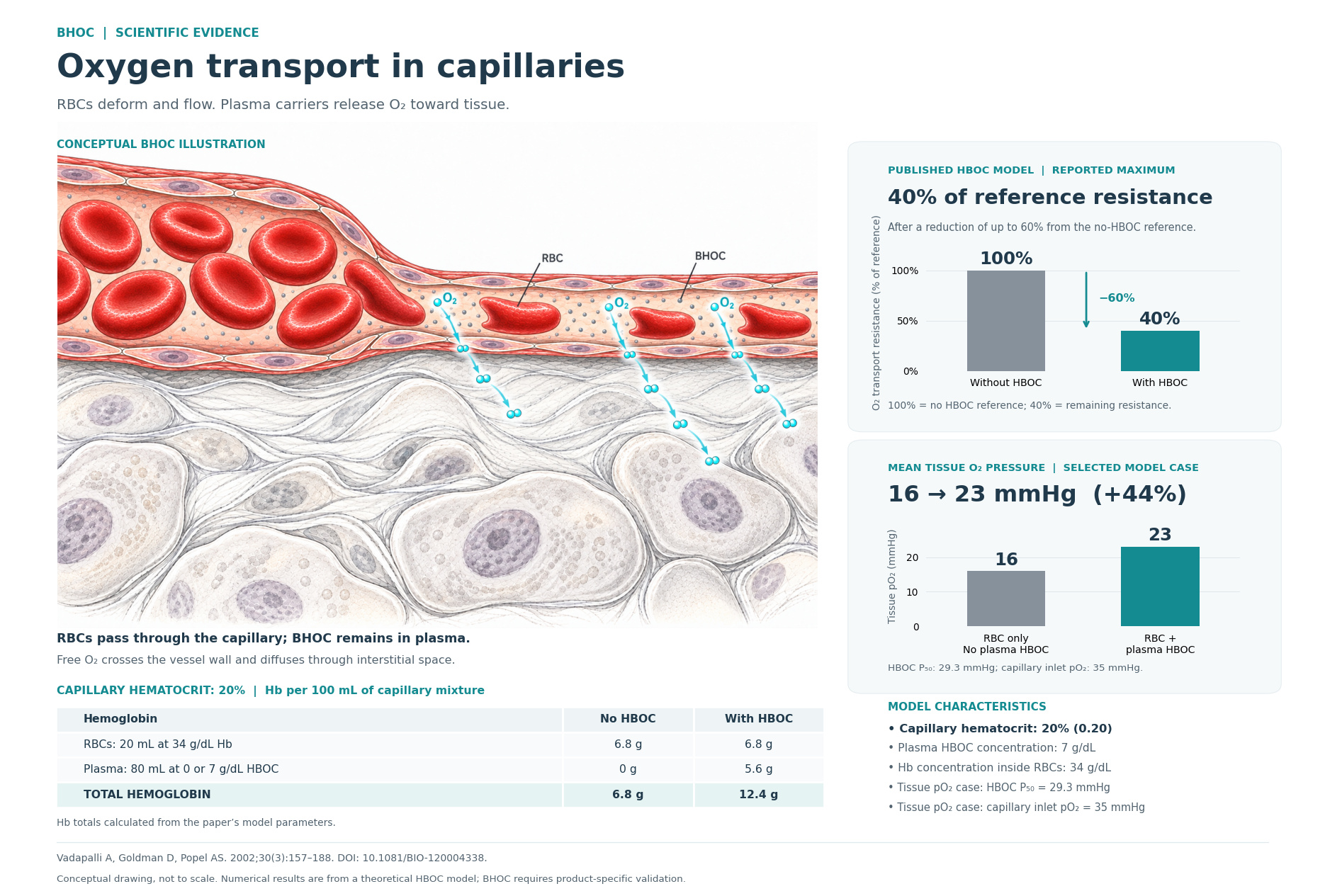
RBCs deform as they pass through capillaries, while small hemoglobin carriers can flow with plasma and release O₂ for diffusion toward tissue.
In a selected model case, Vadapalli, Goldman and Popel (2002) calculated mean tissue pO₂ of 16 mmHg without HBOC and 23 mmHg with 7 g/dL plasma HBOC at 20% capillary hematocrit.
The authors also reported up to 60% lower intracapillary oxygen transport resistance, a separate measure.
HBOC was added to RBCs, increasing total hemoglobin; these theoretical results inform BHOC research and require product-specific validation.
Tissue oxygenation · Microcirculation · Critical care
Normal Hb and SpO₂ do not necessarily mean adequate tissue oxygenation
A discussion of why endothelial dysfunction, microcirculatory impairment, edema, microthrombosis and altered nitric oxide biology can limit oxygen delivery even when conventional blood-level measurements appear adequate. The discussion was also picked up by Hemostasis Today.
A reflection on the scientific relationship of Bing Lou Wong and Carl Rausch, from their early work at Tufts University through Biopure, Hemopure and Oxyglobin, and into the continuing development of oxygen therapeutics. The story connects technology with the people, persistence and institutional memory behind it.
Franck Zal on hemoglobin evolution and oxygen therapeutics
Franck Zal (HEMARINA) shared the BHOC Historical Evolution discussion and added his own perspective on evolution, globin biology, naturally extracellular hemoglobin M101 and therapeutic oxygen delivery.
The New York Times featured Biopure's Hemopure in 2001
David N. Judelson played a major strategic role during Biopure's development years. The post looks at the people, capital and regulatory environment behind one of the earliest commercial oxygen-carrier platforms.
A look at U.S. military collaboration around Hemopure and its relevance to trauma, battlefield medicine and donor-independent oxygen-carrying support in difficult environments.
Global Blood Donation Crisis and the Need for Functional Resilience
Examines repeated blood-shortage warnings across multiple national blood systems and the strategic need to think beyond donor recruitment alone toward functional oxygen-delivery resilience.
Prehospital blood transfusion and the BHOC oxygen-delivery question
Prehospital transfusion is moving closer to the point of injury. The post examines where BHOC and Precision Oxygen Therapeutics may complement donor blood when availability, logistics, storage or time constrain field resuscitation.
Hemoglobin βCys93, NO signaling and tissue oxygen delivery
A BHOC discussion of the 2015 PNAS βCys93 study: normal hemoglobin concentration and oxygen-carrying capacity did not prevent impaired hypoxic vasodilation and reduced tissue oxygenation when a key hemoglobin NO-signaling site was disrupted. The evidence reinforces that oxygen content, vascular regulation and microcirculatory flow must be considered together.
Publications are the conversation layer of the platform.
The BHOC Evidence Platform remains the structured scientific source base. LinkedIn publications and selected external expert perspectives connect evidence, historical context and strategic questions with public professional discussion.