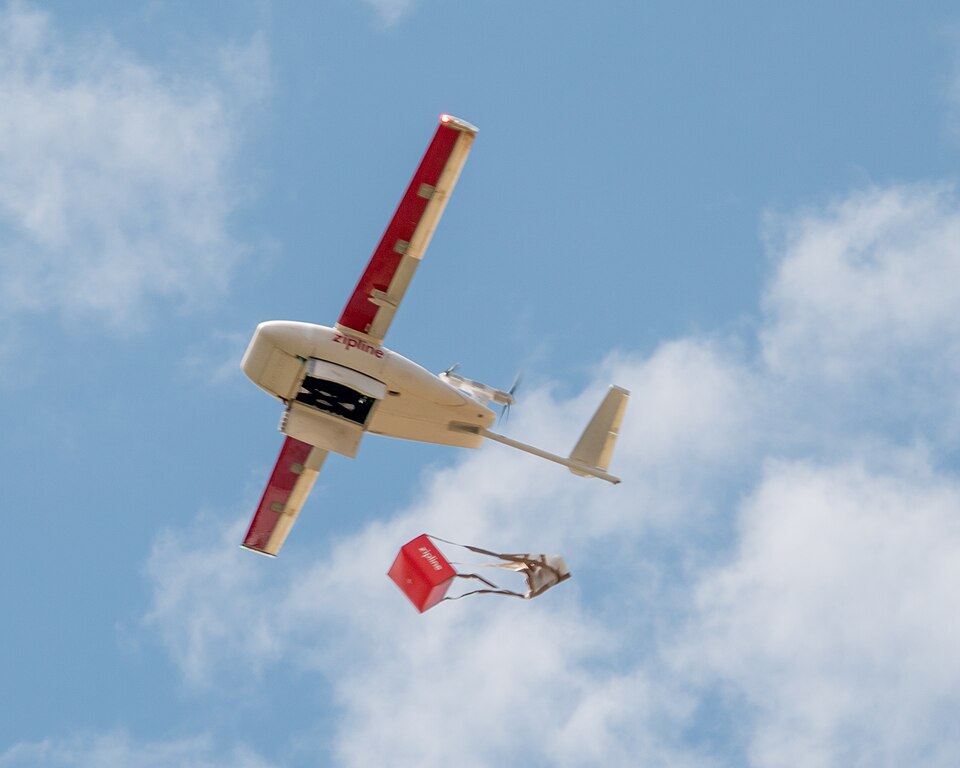
Blood delivery by drone is no longer a concept. It is already part of real health systems. The most interesting question is therefore changing from “can drones deliver blood?” to “why did some health systems move first, and what does that tell us about the next medical innovation?”
Rwanda: urgent need can accelerate adoption
Rwanda launched the world’s first national drone delivery service in 2016. The important point is not that Rwanda had no blood system. The World Health Organization describes Rwanda as having built a high-quality national blood service, with centralized supply and regional distribution. The remaining problem was operational: difficult terrain, damaged roads, distance and the time required to reach remote facilities.
WHO reported that drone delivery could reduce some blood-delivery journeys from about four hours to around 15 minutes. This is a useful example of innovation driven by a problem that the conventional logistics architecture could not solve efficiently enough.
Ghana: from pilot to national operating capability
Ghana then pushed the model further. According to the National Blood Service of Ghana, Zipline completed 4,314 blood and blood-product deliveries in 2025, transporting more than 5,000 units to 96 health facilities. The service described drone logistics as particularly important for hard-to-reach communities and emergency transfusion.
This is not a technology demonstration. It is an operating layer of the health system.
Shenzhen: China shows the next stage — system integration at scale
China was not first to deliver blood by drone. Shenzhen is interesting for another reason: it is showing what happens when the technology is integrated into a large urban blood-supply system.
A 2026 retrospective study from Shenzhen Blood Center describes a 5G-enabled intelligent drone blood-transport platform connecting blood distribution, route planning, emergency dispatch, real-time temperature monitoring, live video surveillance and hospital reception.
As of 31 August 2025, the platform included 18 routes serving 15 hospitals. Between January 2024 and August 2025 it completed 11,784 flights, transporting red blood cells, platelets, plasma and cryoprecipitate. Average flight time was 15.2 minutes. Compared with ground transport, reported average time savings were 46.8 minutes during peak traffic and 32.3 minutes off-peak. The study reported no transport-related product damage or temperature deviations.
The Shenzhen Blood Center had already begun routine deployment in 2024. Its early pilot reduced one route from around 60 minutes by road to as little as nine minutes by drone. By the end of 2024, the city reported 16 routes and 7,070 blood-transport flights.
The sequence of medical innovation may be changing
There is a larger question behind the drone story.
Does every disruptive medical technology still need to follow the traditional sequence of United States first, Europe next, and the rest of the world later?
Not necessarily.
Some technologies may emerge first where the unmet need is greatest. They may scale where health systems can change fastest. They may be clinically validated where scientific and regulatory capabilities are strongest. These processes do not have to happen one after another. They can happen in parallel.
This is not an argument for lower standards in emerging markets. The opposite is required. Safety, manufacturing quality and clinical evidence must remain rigorous everywhere. The opportunity is to stop assuming that geography alone determines the order of innovation.
The better question is:
Where do clinical need, scientific evidence and the ability to implement a solution come together fastest?
What does this mean for blood and oxygen delivery?
Drone logistics are improving the existing donor-blood architecture. That matters. Faster transport can reduce delay, improve access and make blood systems more resilient.
But faster transport does not remove every structural constraint. Blood still has to be donated, collected, tested, processed, stored, matched and available in the required inventory.
That leads to a different question for the future:
After blood logistics are optimized, which critical functions remain dependent on the availability of compatible donor red cells?
One of those functions is oxygen delivery.
Blood is a system. Oxygen delivery is a function.
And the drone story gives us a useful way to watch what comes next.
We should follow not only which technologies are announced, published or presented at conferences, but the sequence in which they move into real use:
Where was the need strongest? Where was the system willing to change? Where was the technology actually implemented? Where did it produce measurable value? And where did the rest of the world follow?
Innovation is what reaches the patient.BHOC Therapeutics
Sources
- World Health Organization — Drones take Rwanda’s national blood service to new heights. WHO describes Rwanda’s national blood service and reports some drone deliveries reducing travel time from approximately four hours to 15 minutes.
- Ghana News Agency — National Blood Service 2025 performance report. Reports 4,314 Zipline blood deliveries, more than 5,000 units and 96 facilities.
- Wu L, et al. 5G Intelligent Airport Platform for UAV Blood Transport in Shenzhen China: A retrospective observational study. Frontiers in Public Health. 2026.
- Shenzhen Blood Center — launch of the 5G + UAV blood-transport intelligent airport platform.
- INSEAD Knowledge — Leapfrogging the African Healthcare Gap. Discusses first-principles system design and the potential to leapfrog legacy healthcare models.
Interpretive statements about innovation pathways and Precision Oxygen Therapeutics are BHOC Therapeutics analysis. They are not conclusions of the cited Rwanda, Ghana, Shenzhen or INSEAD sources.