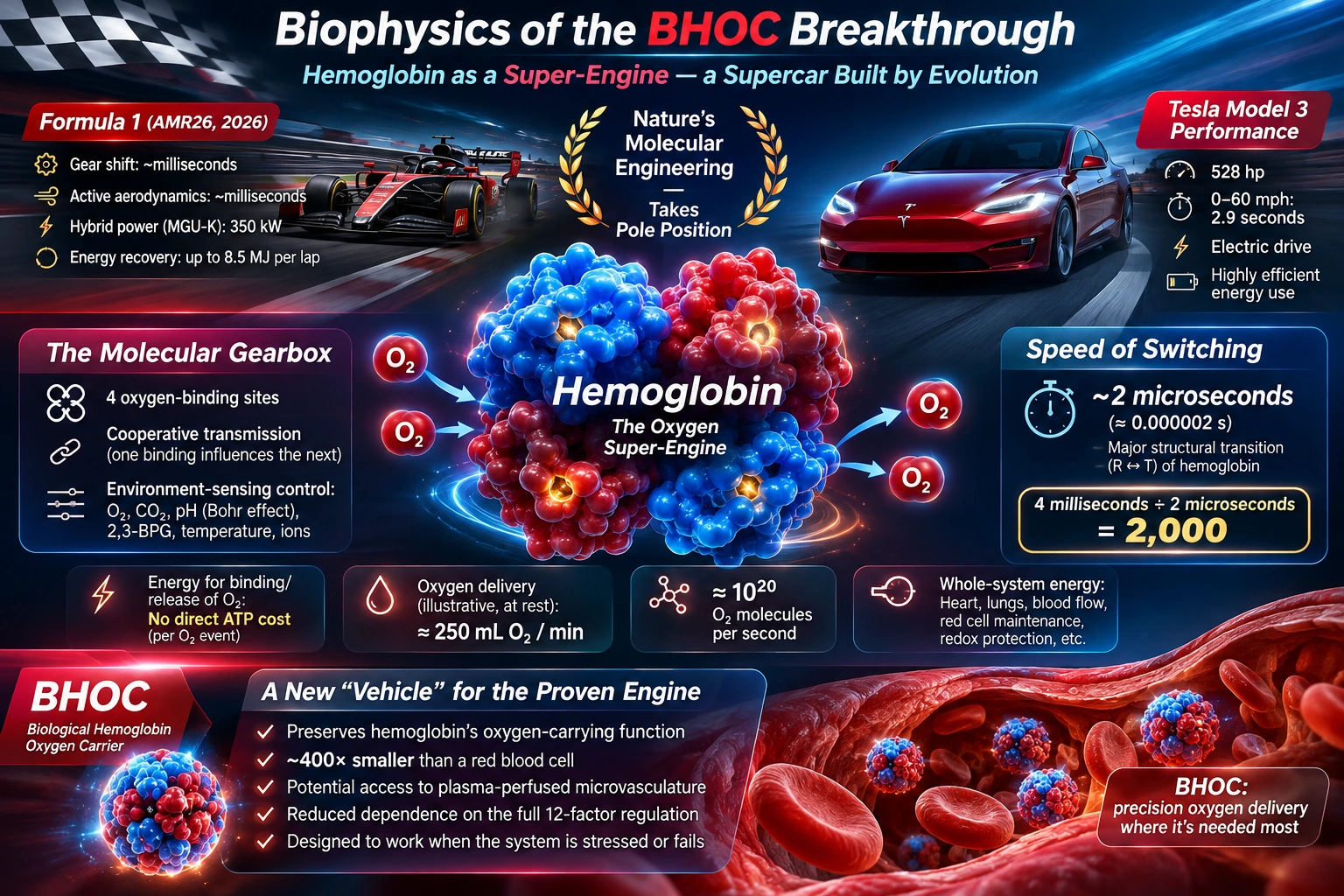
Let us have a little scientific fun. Take a high-performance electric car. Take a 2026 Formula 1 machine. Then put both aside for a moment — because inside blood is a biological molecular system operating on an entirely different scale.
Tesla, Formula 1 — and then hemoglobin
Modern performance cars make extraordinary engineering visible: power electronics, torque control, sensors and software. Formula 1 adds hybrid energy recovery, an eight-speed semi-automatic transmission and active aerodynamics, with key control events occurring on millisecond timescales.
Then there is hemoglobin: no CPU, no battery, no software update. Yet this protein loads oxygen, changes molecular configuration, responds to its chemical environment and releases oxygen as conditions change.
The molecular gearbox
A hemoglobin tetramer has four oxygen-binding sites. They are not four independent hooks. Binding changes the protein, and that structural change influences the remaining sites. During unloading, the molecular state shifts again. This is cooperativity — a molecular transmission whose behavior depends on its environment.
That is why the engineering analogy is useful, as long as we remember it is an analogy. Hemoglobin does not have four literal mechanical gears; it has coupled molecular states, binding equilibria and kinetics.
How fast can biology “shift gear”?
In a laboratory study of human hemoglobin, a major R→T structural rearrangement following ligand release was observed on a timescale of roughly 2 microseconds.
4,000 μs ÷ 2 μs = 2,000.
Human engineering often works in milliseconds. Molecular biology can move in microseconds.
Tesla can become faster. Formula 1 can become faster. Tesla may even fly one day. The passenger inside will still depend on hemoglobin.
The energy question may be even more interesting
Hemoglobin does not hydrolyze an ATP molecule every time it binds one O₂ molecule, and it does not pay another ATP “transaction fee” every time oxygen is released. Reversible oxygen binding is governed by molecular chemistry, thermodynamics and the surrounding oxygen gradient.
Nature does not work for free, of course. The heart pumps. The lungs ventilate. Red cells maintain their membranes and redox systems. Blood vessels regulate flow. But the molecular binding/unbinding event itself does not require direct ATP hydrolysis for every oxygen passenger.
What scale are we talking about?
For an illustrative adult at rest, a simplified oxygen-extraction calculation can be written as:
≈ 250 mL O₂ transferred from blood to tissues per minute
≈ 10²⁰ O₂ molecules per second as an order-of-magnitude illustration.
That number is not a measure of BHOC performance. It is a way to appreciate the throughput of the biological oxygen-transport system we normally take for granted.
Blood is an ecosystem
Hemoglobin does not race alone. The red blood cell is its vehicle and maintenance platform. The heart is the pump. The vascular network is the highway. The microcirculation is the last-mile distribution system. The lungs are the loading station. Mitochondria are the final oxygen consumers.
This is why a hemoglobin concentration by itself cannot describe the entire oxygen-delivery function. The deeper question is whether oxygen can reach the tissue that needs it, at the required time and in a usable form.
BHOC: keep the function, change the vehicle
BHOC — Biological Hemoglobin Oxygen Carrier starts from an engineering question: what happens if we preserve hemoglobin-mediated oxygen transport but place it into a different, cell-free architecture?
A red blood cell is micrometer-scale. A cell-free hemoglobin oxygen carrier operates at a much smaller molecular or macromolecular scale. That can change geometry, diffusion distances and interaction with plasma-perfused microvascular pathways. Whether those differences produce a useful physiological effect must be demonstrated for each formulation and clinical context.
Perhaps the real breakthrough is humility
This is deliberately a scientific-popular perspective. The comparisons simplify complex systems so that the scale becomes intuitive. They do not imply that a molecule, an electric vehicle and a Formula 1 gearbox perform the same task.
The closer we look at hemoglobin, erythrocytes, microcirculation, oxygen gradients and mitochondria, the more obvious it becomes how much sophisticated biology remains to be understood.
Formula 1 is extraordinary engineering. Tesla is extraordinary engineering. But nature had a very long R&D programme.
Biology takes pole position.
Sources and further reading
- Cammarata M, Levantino M, Wulff M, Cupane A. Unveiling the Timescale of the R–T Transition in Human Hemoglobin. Journal of Molecular Biology. DOI: 10.1016/j.jmb.2010.05.057 ↗
- Tesla. Model 3 Performance — current manufacturer specifications. Tesla ↗
- Honda. 2026 AMR26 — F1 Machine Powered by Honda. Honda Racing ↗
- BHOC Therapeutics. Oxygen-delivery science → · Biological Hemoglobin Oxygen Carrier technology → · What is BHOC? →
Popular-science FAQ
Is hemoglobin really 2,000 times faster than Formula 1 or Tesla?
No. The 2,000 figure compares an illustrative 4 millisecond interval with a measured ~2 microsecond molecular transition. They are different processes.
What does the ~2 microsecond value mean?
It is a measured timescale for a major R→T structural rearrangement of human hemoglobin under specific laboratory conditions after ligand release. It is not total lung-to-tissue oxygen-delivery time.
Does hemoglobin spend ATP to bind and release each oxygen molecule?
No direct ATP hydrolysis is required for each reversible binding or release event. The cardiovascular, respiratory and red-cell maintenance systems still consume energy.
What is BHOC?
BHOC means Biological Hemoglobin Oxygen Carrier. It is the BHOC Therapeutics framework for studying cell-free hemoglobin-mediated oxygen delivery within Precision Oxygen Therapeutics.