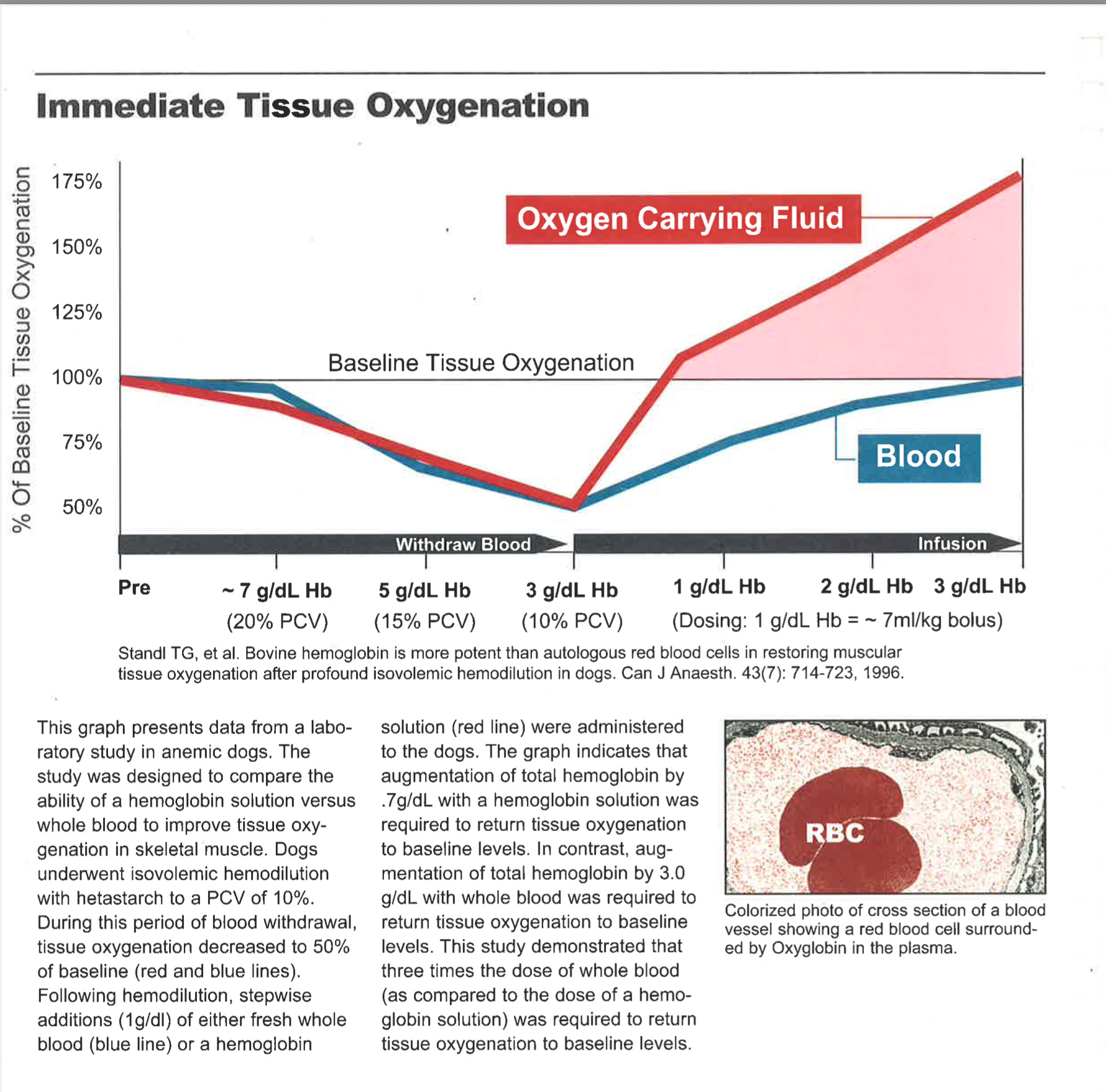
In 1996, Thomas Standl and colleagues demonstrated restoration of muscle tissue oxygenation with polymerized bovine hemoglobin after severe hemodilution in dogs.
Researchers withdrew blood from 24 anesthetized dogs while maintaining circulating volume with hetastarch, reducing hematocrit to 10%. They then compared stored autologous red cells, fresh autologous blood and a polymerized bovine hemoglobin solution. Oxygen tension was measured directly in skeletal muscle.
In the hemoglobin-solution group, mean tissue oxygen tension fell from 32.6 to 15.9 mmHg after hemodilution. A rise in total blood hemoglobin of 0.7 g/dL restored it to 34.6 mmHg, reaching the original oxygenation level.
| Treatment | Hb increase associated with restoring baseline tissue oxygenation |
|---|---|
| Polymerized bovine hemoglobin solution | 0.7 g/dL |
| Fresh autologous blood | 2.1 g/dL |
| Stored autologous red cells | 2.7 g/dL |
The solution provided oxygen-carrying hemoglobin in plasma. The authors linked its greater tissue oxygenation effect to more pronounced oxygen extraction. Oxygenation recovered without red-cell transfusion in that treatment group.
This is what we mean by Precision Oxygenation Therapeutics. Oxygen must be loaded, transported through the circulation and released where tissue needs it. Hemoglobin concentration and red-cell volume remain important measurements; however, the therapeutic objective is oxygenation of tissue.
The experimental result was already there in 1996. Three decades of accumulated science have given us a more detailed understanding of oxygen affinity, plasma transport, HIF, microcirculation and more. We can now return to this work, reconsider what was demonstrated and interpret its significance through the knowledge available today.
The FDA Oxyglobin assessment separately documented preservation of the normal regenerative response to anemia. This is relevant to oxygen support while the body's own red-cell production recovers.
For BHOC (Biological Hemoglobin Oxygen Carrier), we are returning to an experimentally demonstrated oxygen-delivery function and placing it in the broader physiological framework we understand today.
Sources
- Standl T, Horn P, Wilhelm S, et al. Bovine haemoglobin is more potent than autologous red blood cells in restoring muscular tissue oxygenation after profound isovolaemic haemodilution in dogs. Can J Anaesth. 1996;43:714-723. PubMed record ↗ · Original paper ↗.
- FDA. Oxyglobin, NADA 141-067. Original Freedom of Information Summary, page 13. Original FDA assessment ↗. Our Oxyglobin regulatory source record →.
Explore the scientific evidence library → · Precision Oxygen Therapeutics → · Oxygen sensing, HIF and the Nobel foundations →
Questions about the study and tissue oxygenation
What did the 1996 tissue oxygenation study demonstrate?
In a canine hemodilution experiment, polymerized bovine hemoglobin restored baseline muscle tissue oxygenation with a 0.7 g/dL rise in total blood hemoglobin, compared with 2.1 g/dL using fresh autologous blood and 2.7 g/dL using stored autologous red cells.
What do the 0.7, 2.1 and 2.7 g/dL values represent?
They are increases in total blood hemoglobin associated with restoring baseline muscle tissue oxygenation in the experiment. They are concentration increments, rather than infused volumes or final hemoglobin concentrations.
What does BHOC mean by Precision Oxygenation Therapeutics?
The therapeutic objective is oxygenation of tissue. Oxygen must be loaded, transported through the circulation and released where tissue needs it. Hemoglobin concentration and red-cell volume remain important measurements within that functional assessment.