Scientific perspective · 12 October 2026
US Prehospital Blood Transfusion: NHTSA and AABB Initiatives in the Context of Precision Oxygen Therapeutics
Two independent US consultations on access and transfusion standards raise a larger clinical question: what happens when oxygen is needed before donor blood arrives?
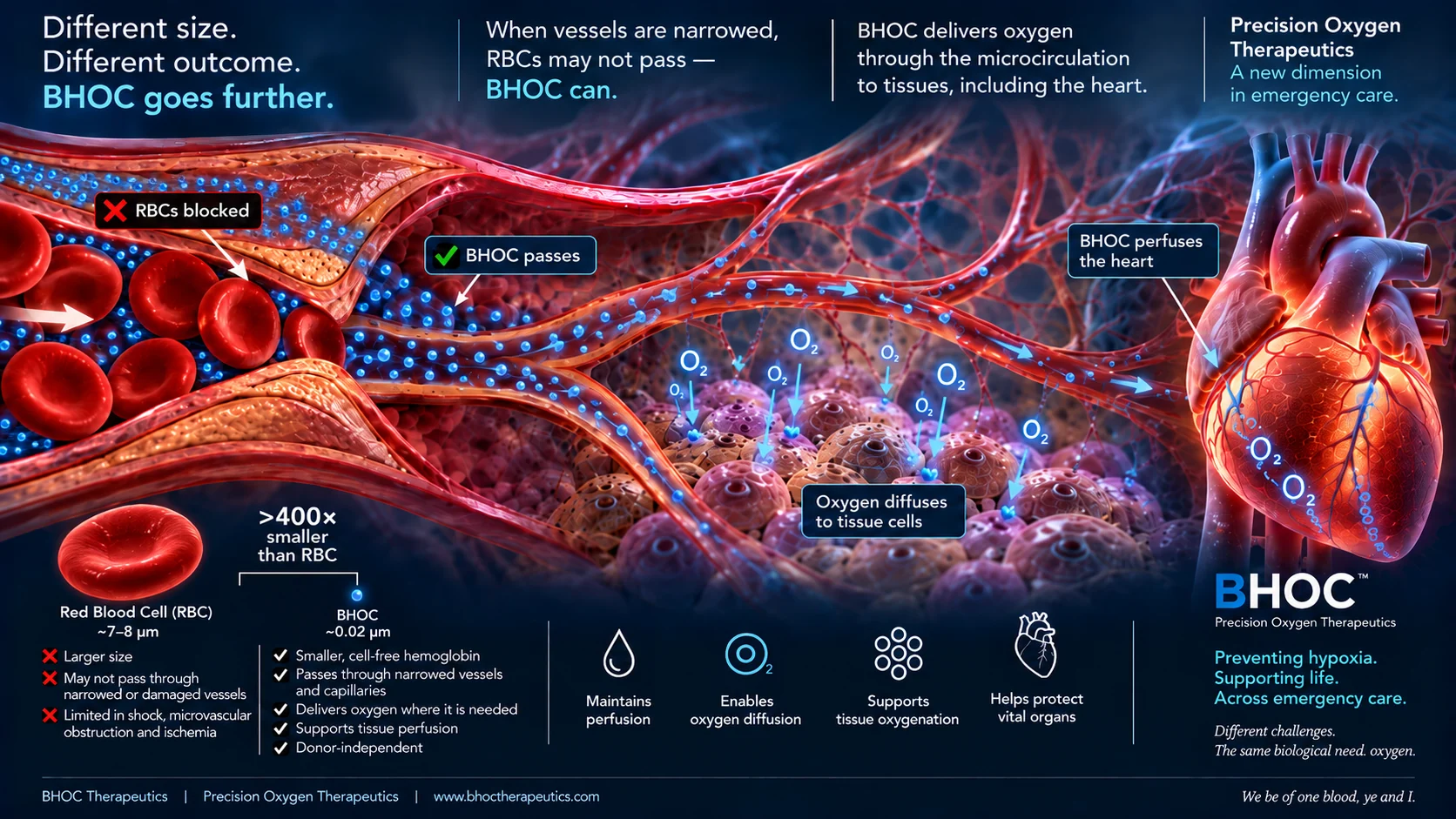
Blood flow is not synonymous with tissue oxygenation. Perfusion, oxygen diffusion and cellular oxygen utilization represent related but distinct clinical targets.
Two important US consultations
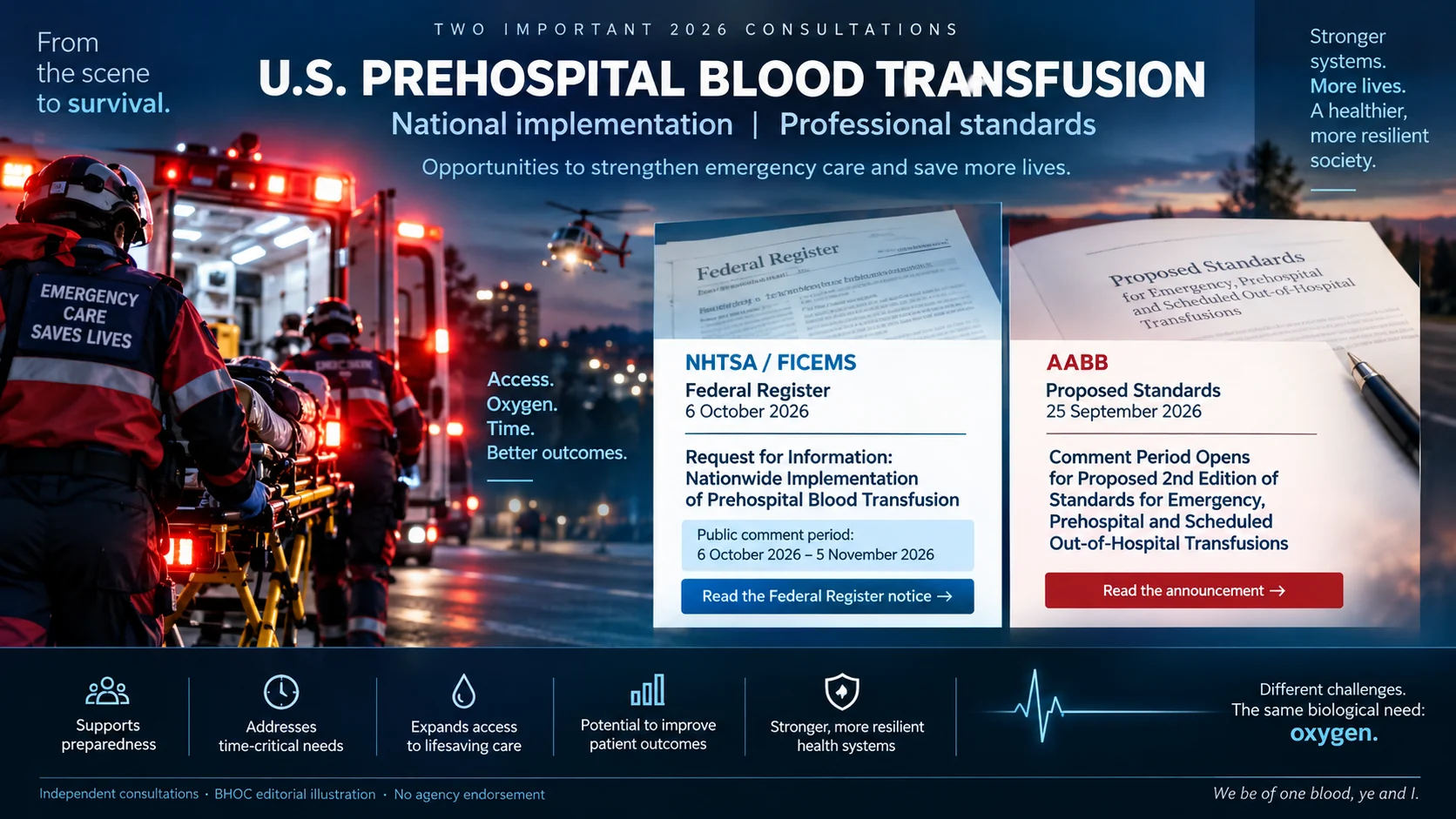
On 6 October 2026, the National Highway Traffic Safety Administration (NHTSA), acting on behalf of the Federal Interagency Committee on Emergency Medical Services (FICEMS), published a Request for Information concerning nationwide implementation of prehospital blood transfusion. Separately, on 25 September 2026, AABB announced a comment period for the proposed second edition of its Standards for Emergency Prehospital and Scheduled Out-of-Hospital Transfusions. These are independent processes, not a joint program or an endorsement of BHOC Therapeutics.
2028 ambitions: expanding access before blood arrives
FICEMS seeks ideas on barriers and solutions for expanding programs across state, local, tribal and territorial EMS and 911 services. Its 2028 targets include 2,028 EMS agencies with active prehospital blood transfusion programs, administering prehospital transfusion to 16% of all patients and 28% of pediatric patients with life-threatening bleeding, and improved outcomes reporting through NEMSIS. The notice describes aspirations to help prevent up to 10,000 deaths annually and reduce overall mortality from severe bleeding by 5%. These are targets, not demonstrated outcomes. Public comments on the RFI close on 5 November 2026.
AABB: complementary work on professional standards
AABB is separately consulting on its proposed second edition of standards addressing emergency prehospital and scheduled out-of-hospital transfusion. A standards consultation is distinct from the national implementation RFI. Both can inform future discussions of safety, logistics, quality and clinically meaningful outcomes. Neither consultation evaluates or approves a particular BHOC product.
A functional question for emergency medicine
Blood performs several functions, including hemostasis, volume support and oxygen transport. Each can become limiting in a different way. BHOC Therapeutics proposes asking not only how quickly donor blood can arrive, but which function needs immediate restoration, why it is limited and how its recovery should be measured. The goal is to discuss a potential bridge to definitive care, not to replace transfusion, hemorrhage control, surgery or established resuscitation.
Perfusion, diffusion and tissue oxygenation are not interchangeable
Perfusion is the passage of blood through the microvasculature. Oxygen diffusion is the movement of oxygen down a partial-pressure gradient from capillary blood toward tissues. Hemoglobin concentration, arterial oxygen saturation, macrovascular flow and effective tissue oxygenation are related but different measures. Tissue oxygen availability depends on oxygen content and flow, microvascular architecture, oxygen unloading, diffusion distance and cellular consumption. Increasing hemoglobin content alone cannot guarantee tissue-level recovery.
Beyond hemorrhage: myocardial ischemia and reperfusion
The distinction is particularly relevant to acute myocardial infarction. Restoring coronary flow rapidly is an essential treatment objective; however, microvascular dysfunction and ischemia-reperfusion injury may persist after reopening the culprit artery. BHOC Therapeutics believes that limiting tissue hypoxia deserves investigation as a measurable therapeutic target alongside established reperfusion strategies. Precise oxygen management is not synonymous with simply giving more oxygen. Hyperoxia may be harmful, and there is no universal golden-hour cutoff for all myocardial infarctions.
Precision Oxygen Therapeutics: a proposed direction
Our perspective is that controlled oxygen availability, assessed in relation to clinical timing, perfusion and tissue response, may warrant investigation as a distinct therapeutic strategy in hemorrhage, selected shock states, myocardial ischemia and transplantation. Historical hemoglobin-based oxygen carrier experience informs this discussion, but it is not proof of the safety, efficacy or regulatory status of a new BHOC technology. The accompanying BHOC image is a conceptual illustration, not a demonstration of verified capillary passage or clinical outcomes.
The next questions
What is the patient's immediate physiological deficit? How early can tissue hypoxia be recognized? What do we know about microvascular perfusion and diffusion when conventional systemic variables look adequate? Which endpoints predict meaningful improvement for patients rather than only documenting the number of units infused? These are the questions we suggest adding to a broader dialogue about prehospital readiness.
An invitation to scientific dialogue
BHOC Therapeutics welcomes evidence-based discussion with emergency medicine, transfusion medicine, cardiovascular and microcirculation researchers. Both US consultation processes are independent of BHOC, and this article does not imply endorsement by NHTSA, FICEMS or AABB.