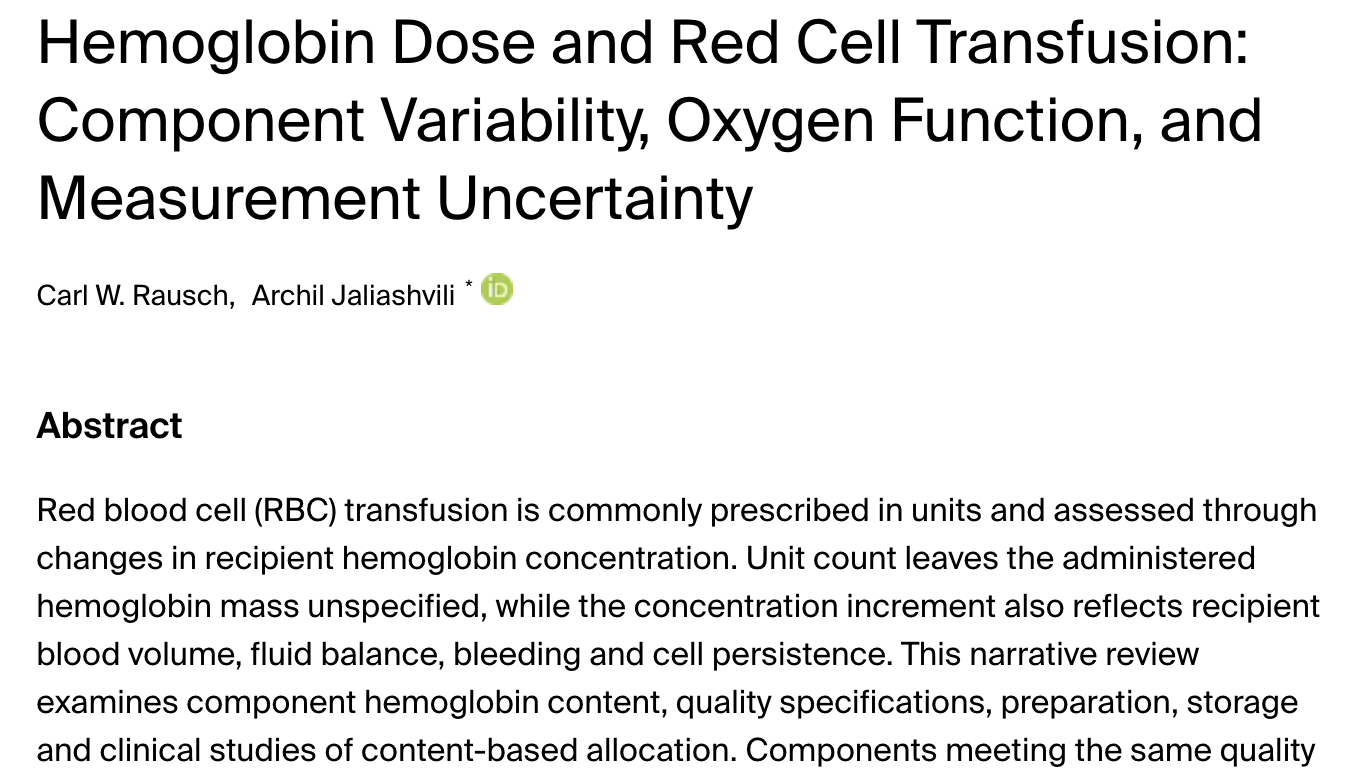
What does one red cell unit tell us?
Red blood cell transfusion is commonly prescribed in units and assessed through the recipient's hemoglobin concentration. The review examines a practical measurement question: how much hemoglobin was actually administered, and what additional information is needed to assess its oxygen-delivery function?
Components meeting the same quality specifications can contain different hemoglobin masses. Collection, processing, anticoagulants, additive solutions and storage help define the final component. The recipient's hemoglobin increment also reflects blood volume, fluid balance, bleeding and the persistence of transfused cells.
Connecting dose measurements with physiological response
The authors distinguish component hemoglobin content, administered hemoglobin mass and the recipient's measured response. Oxygen affinity and oxygen-release kinetics provide functional information that concentration and mass alone do not capture.
The proposed next step is prospective research linking representative final-component measurements with delivered volume, recipient physiology and samples collected at defined times. The first question is whether measured administered hemoglobin mass improves prediction of the recipient increment beyond routine component and patient data. Further studies can assess the additional value of oxygen-release measurements and perfusion variables.
This work extends the measurement questions discussed in the BHOC Precision Oxygen Therapeutics research direction. Clinical benefit would need independently measured physiological and patient outcomes. The proposed studies retain established compatibility requirements and patient blood management practice.
Acknowledgments
The authors thank the following colleagues for their contributions to the preparation of this manuscript:
- Dr Arun V. J.
- Ari Gargir
- Sarah Walbolt
- Ahmed Sannat Alotaibi
- Zahra Ghasemi
- Tom Ferry
- Lee Ka Yan Karen