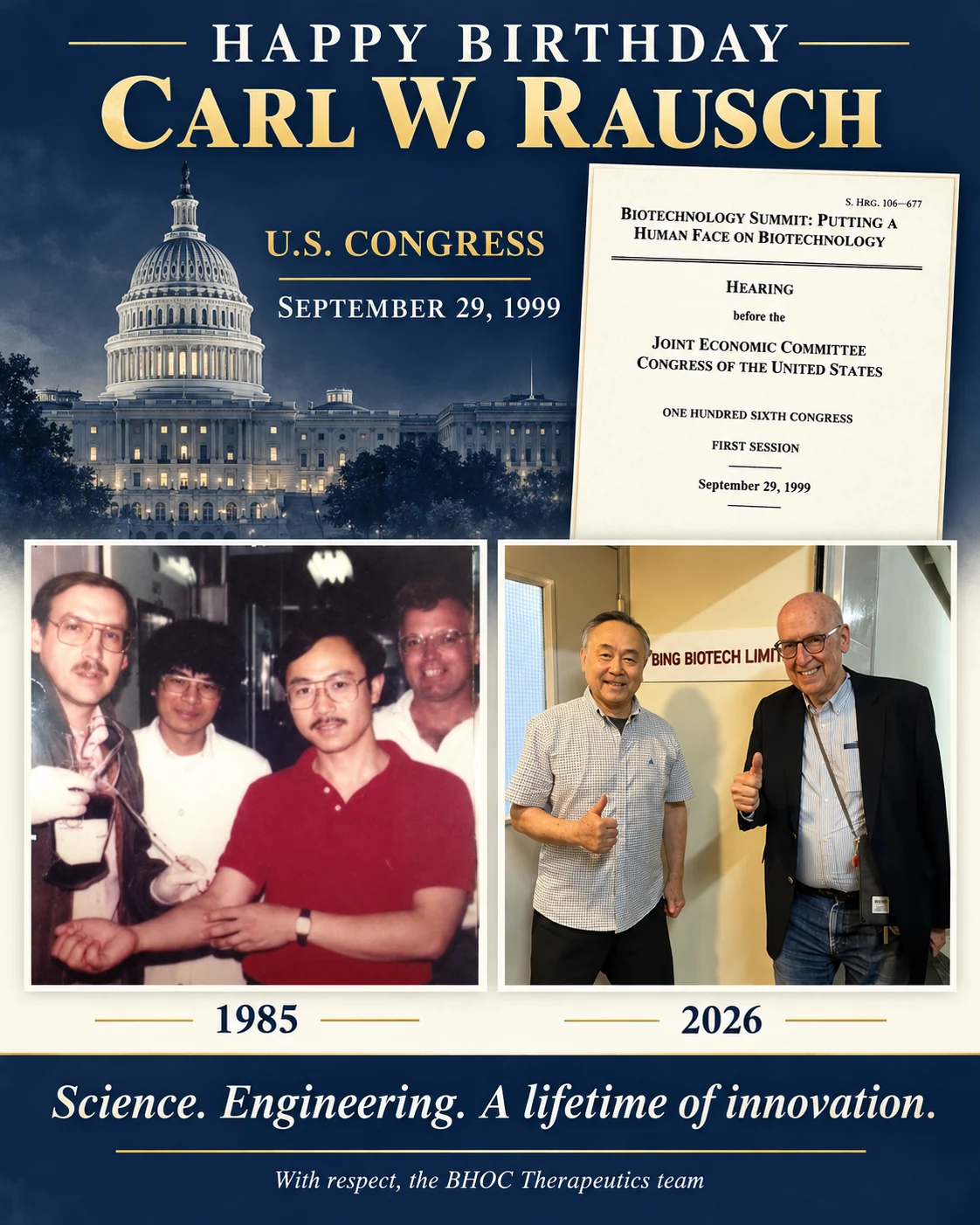
Carl, the whole BHOC Therapeutics project team wishes you a happy birthday.
We wish you good health, energy, new discoveries and oxygen to every cell. We have great respect for you and are happy to work with you. The further we go with our work, the more we understand the scale of what you have created and continue to develop.
Your professional experience brings together chemical and medical engineering, biotechnology, industrial production and company leadership.
Education and professional experience
Your education includes:
- B.S. in Chemical Engineering, Tufts University.
- M.S. in Medical Engineering, Tufts University.
- M.S. in Chemical Engineering, Massachusetts Institute of Technology, MIT.
Your professional roles have included Vice President of Preparative and Process Chromatography at Millipore; co-founder, Chairman and CEO of Biopure, and later its Vice Chairman and Chief Technical Officer; and subsequently CEO, CFO and a member of the Board of Directors of Boston Therapeutics.
Today, in the BHOC Therapeutics project, you continue as our Chief Scientific Officer and Chief Technology Officer. And, to be honest, with the responsibility you carry, the decisions you make and the daily work you do, you also perform the functions of CEO.
For us, you are a real innovator who was ahead of his time. You helped create a new direction and carried the work through molecule development, production technology, scale-up, clinical trials and bringing products to market.
And this work continues.
Nature, engineering and the continuing development of BHOC
Nature has created a remarkable engineering system for oxygen transport and delivery. Hemoglobin is one of its central elements. Through biotechnology, we study this natural system and translate its functional principles into therapeutic solutions. Engineering continues to improve how we manufacture, purify, standardize and control these products.
Carl has continued improving the technology through all these years. Today, we are developing BHOC, Biological Hemoglobin Oxygen Carrier, within Precision Oxygen Therapeutics, as a platform connecting proprietary technology, knowledge of oxygen function and modern manufacturing.
Our development direction includes modular production, robotic operations, the greatest possible use of real-time process monitoring, digital traceability and integrated quality assurance and quality control, QA/QC. The purpose is to make it possible to establish production modules closer to where they are needed, while maintaining defined product characteristics as production grows.
The technology keeps improving. Science gives us more precise explanations of what was observed, allows us to test what was predicted and understand the conditions in which those predictions are confirmed.
U.S. Congress, blood transfusion, RBCs and prehospital oxygen delivery
To see how far ahead Carl was thinking, we can return to his testimony on September 29, 1999, before the Joint Economic Committee of the United States Congress, held in the Hart Senate Office Building.
His presentation was called "Oxygen Therapeutics as Alternatives to Red Blood Cells." It connected blood transfusion and red blood cells (RBCs) with a broader question of timely oxygen delivery, including the problems we now discuss in prehospital care.
These were his main points.
- A small company can change a whole field of medicine. Biopure, founded in 1984, had around 175 employees. It was developing technology with potential importance for millions of patients.
- Oxygen therapeutics represent a distinct direction in biopharmaceutical development. Purification and modification of hemoglobin made it possible to develop products intended to deliver oxygen to tissues and organs.
- The problem is medical, economic and logistical at the same time. Patient outcomes, access to treatment, organization of care and total costs all need to be considered.
- The scale of need is enormous. Carl cited the figures available at that time: more than 12 million units of blood donated and around four million patients receiving transfusions each year in the United States.
- Regional blood shortages can become a national problem. He discussed a projected shortage of up to 300,000 red-cell units, potentially approaching 550,000 when new donor restrictions were considered.
- Storage and compatibility determine whether treatment is available. Carl described Biopure's products as having a two-year shelf life at room temperature and compatibility with all blood groups.
- Progress in the donor-blood system does not remove all its limitations. He recognized improvements in transfusion safety while drawing attention to the biological and organizational challenges that remained.
- Pharmaceutical manufacturing requires reproducible product characteristics. Identity, strength, purity, quality and the manufacturer's responsibility are part of the technology itself.
- New infectious threats can appear before diagnostic tests become available. Carl emphasized the importance of validated purification processes for removing potential infectious agents.
- The price of a blood unit does not represent the full cost of treatment. Complications and additional hospitalization create costs that must be included in an economic comparison.
- We need to assess oxygen function. Carl discussed how red-cell storage can affect oxygen delivery and why timely oxygen support matters.
- Veterinary medicine was already providing practical experience with the technology. He described Oxyglobin for treating anemia in dogs and reported that it had helped save hundreds of animals.
- Development for human use was undergoing clinical evaluation. Hemopure was in a pivotal Phase III trial assessing its ability to avoid donor red-cell use in surgery. Carl also reported fast-track review status in South Africa.
- Oxygen therapeutics could have applications beyond conventional transfusion indications. Already then, Carl named heart attack, stroke and oxygenation of hypoxic tumors to improve their response to chemotherapy or radiation as development areas.
- The molecule must become a stable and functional pharmaceutical product. He described purified bovine hemoglobin, chemically modified to increase its stability in the body.
- In critical conditions, time matters. Timely oxygen delivery was presented as a way to help prevent tissue damage and death, including in emergency care in the field.
- Remote areas need accessible means of oxygen support. Ease of storage and use could expand treatment possibilities in the United States and around the world.
- Maintaining medical readiness is itself expensive. Referring to Desert Storm, Carl cited an estimate of almost one million dollars per day to maintain blood readiness, while much of the blood held in reserve went unused.
- Oxygen therapeutics could support the blood-supply system. He connected their potential role with treatment availability, costs, infectious risks and the complexity of blood-banking infrastructure.
- Scientific development needs a sustainable economic model. By the time of his testimony, Biopure had raised $300 million. A return on investment was necessary to continue the work and bring the technology to patients.
- The comparison must include the full cost of care. Blood collection, storage, distribution, administration and subsequent patient management should be considered together.
- Payment systems need to reflect medical progress. Carl called for updated reimbursement approaches that recognized additional safety procedures and the arrival of new technologies.
- Patent protection should account for the time required by regulatory review. A substantial part of a patent's life can pass before commercialization, reducing the opportunity to recover development investment.
- Oxygen support can provide time to treat the underlying disease. Carl described a 21-year-old woman with severe immune-mediated hemolytic anemia and a hematocrit below 4%. According to his testimony, Hemopure was administered over eight days, supporting her until the hemolytic process could be controlled. She subsequently recovered and was discharged from hospital.
- Making the technology available requires science, industry, medicine and government to work together. His closing appeal concerned the conditions needed for oxygen therapeutics to fulfil their potential.
Twenty-seven years later: a new stage of Precision Oxygen Therapeutics
Twenty-seven years have passed.
Which of Carl's main propositions has not found scientific or practical support by today?
Carl's vision has gained new scientific and practical grounding. Science has advanced. The technology has advanced. And we are moving forward.
We are rethinking and repurposing the product as a therapeutic drug for functional support, adjustment and delivery of oxygen.
We are evolving into a new stage of Precision Oxygen Therapeutics.
Carl, thank you for looking ahead, creating and continuing to improve what you have created. We are happy to be part of this work with you.
Happy birthday!
Archil Jaliashvili
On behalf of the whole BHOC Therapeutics project team
Carl's oral testimony appears on printed pages 119-122, and his extended written testimony on pages 236-239.